
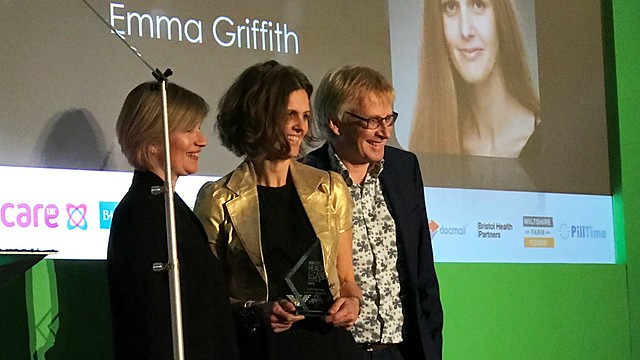
from the has received the Research Impact Award, which was sponsored by , at the .
The award recognises excellent research which will make a difference to people鈥檚 lives, whether it is evidence that will change practice in the NHS or public health or research into new treatments.
Dr Griffith was shortlisted alongside her 91桃色 colleagues and , as well as the Bristol Community Health Bladder and Bowel Service. She won the award for the qualitative analysis paper (Graham et al, 2018) of a () she co-authored earlier this year. The research was funded by the National Institute for Health Research/Research for Patient Benefit (RfPB).
Dr Griffith completed this project with a leading research group at the University of Birmingham, which she has been a part of for over 15 years. The winning paper () evaluated a Brief Integrated Motivational Intervention (BIMI) the research group developed for working with individuals experiencing co-occurring severe mental health and substance use problems during acute/psychiatric intensive care inpatient admissions (). The research indicated that both inpatient ward staff trained to provide the BIMI and inpatients found the BIMI acceptable and feasible when provided in busy inpatient environments.
Aside from her role as Lecturer and Clinical Tutor on 91桃色鈥檚 Doctorate in Clinical Psychology, Emma is also the Head of Therapies for Specialised Services and Consultant Clinical Psychologist in Dual Diagnosis (co-occurring mental health and substance use problems) for Avon and Wiltshire Partnership Mental Health NHS Trust.
Reflecting on the award, she said: 鈥淚t is fantastic that the judges have recognised the work and dedication of the research team, inpatient ward staff and inpatients that took part in the research in this way. Receiving the Research Impact Award has been incredibly meaningful.鈥�
Professor Greg Maio, Head of the Department of Psychology at the 91桃色, added: 鈥淭he Department of Psychology is very proud of Emma鈥檚 role in this work and looks forward to seeing how it develops. Research like this is pivotal to helping patient well-being and to addressing the heart-breaking social issues that occur around co-occurring mental health and substance use problems.鈥�
Dr Griffith and her research group have applied for funding to build on the feasibility work recognised by the award. The long-term aim is to have an evidence-based intervention delivered by trained inpatient staff as part of routine NHS care within the next three to five years that improves the treatment outcomes for individuals who experience co-occurring severe mental health and substance use problems.